Ouuuhlala.golf is live, but Ouuuhlala.golf is not finished.
That distinction matters. A website can be visible, useful and already rich in hundreds of pages while remaining a project in active development. Behind the products, articles and configurators seen by visitors, a larger infrastructure continues to be built, tested and consolidated.
In our “When Golf Products Could Talk” series, each object explains its role through use. The towel protects logo visibility. The tee begins every hole. The divot tool speaks for care of the green. Apply the same idea to the platform and Ouuuhlala.golf might say that it connects the product, the content, the customer request and the work that follows.
A visible website, a platform under construction
To the public, Ouuuhlala.golf is first a specialist website for custom golf products. A visitor opens a product page, guide, gallery or configurator. That visible experience is essential, but it represents only part of the project.
Behind the public pages are tools for content, products, pricing calculations, logo preparation, customer requests, SEO, social campaigns, editorial validation and operational monitoring. The project is therefore better understood as a bilingual business platform in development than as a conventional brochure website.
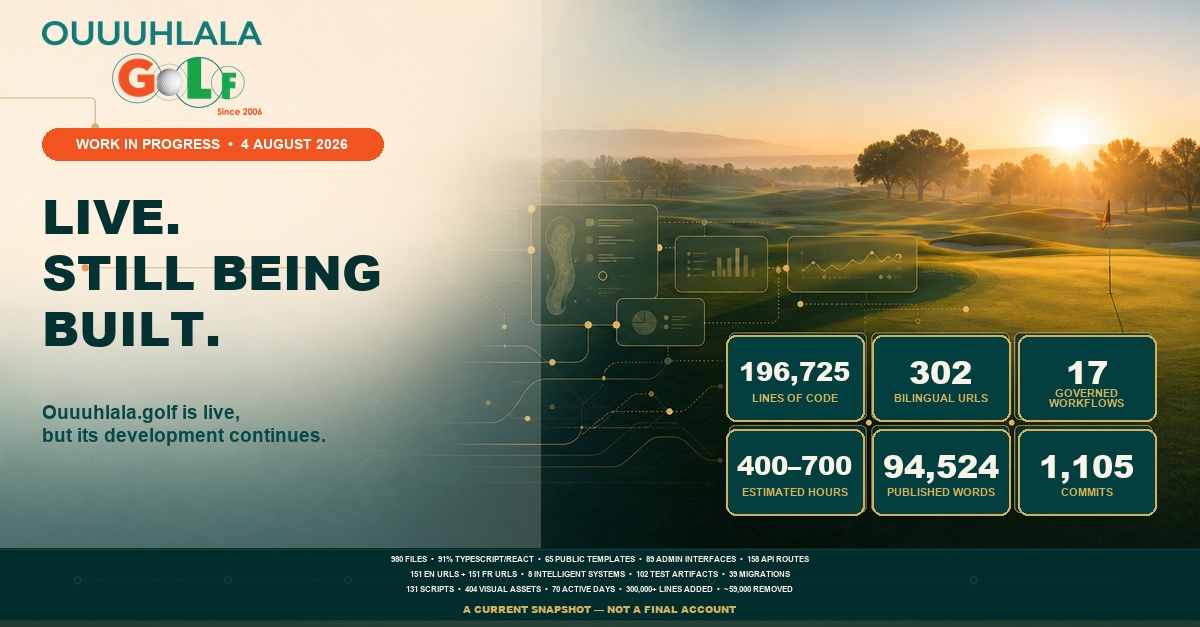
The figures in this article are a dated snapshot of the project on 4 August 2026. They describe one stage of development, not a final account.
What 196,725 lines of code actually represent
At this date, the project contains 196,725 lines of code across 980 files. Approximately 91% is written in TypeScript and React. The platform includes 65 public page templates, 89 administration interfaces and 158 API routes.
Those numbers matter only when connected to responsibility. A product page must present reliable information. A configurator must turn technical options into a clear request. An administration interface must support correction, approval and publication. An API route must carry information without losing its meaning.
Code volume is therefore not only a measure of work. It represents the connections required between the visible experience and the operations that make it possible.
Bilingual by architecture, not as an afterthought
The public sitemap currently contains 302 URLs, divided evenly between 151 English pages and 151 French pages. These include 106 article URLs, 92 product URLs, 24 category URLs and 24 configurator URLs.
The public content database contains approximately 94,524 words: about 49,830 in French and 44,694 in English. This conservative estimate excludes some navigation, forms, configurator guidance and static text held directly in the code.
Each language must still work as a complete experience. Titles, technical explanations, commercial journeys, SEO metadata and internal links must remain coherent. Bilingual publishing is therefore an architectural, editorial and quality-control responsibility, not a translation task added at the end.
Eight intelligent systems and seventeen governed workflows
The platform groups eight major areas of assisted work: SEO, competitor analysis, social content, knowledge and evidence, executive reporting, commercial opportunities, product research and editorial production.
Under those areas are 17 registered autonomous workflows. Nine can operate automatically within fixed limits. Two have stronger decision rules. Four produce proposals requiring approval. Social publishing only accepts validated content, while certain failures stop and request human review.
The word “agent” does not mean that an independent intelligence acts freely at all times. Here it describes an intelligent work area governed by limits, controls, operating evidence and escalation.
Between 400 and 700 hours, with an important caveat
Git history records 1,105 commits across 70 active development days. Activity analysis supports an estimate of 400 to 700 hours covering implementation, testing, preparation and deployment.
This range is neither an invoice nor a timesheet. Git cannot capture every hour of thinking, research, offline testing or every contribution in an AI-assisted environment. It nevertheless provides a defensible order of magnitude.
Other evidence adds context: 102 test artifacts, 39 database migrations, 131 operational scripts and 404 images or visual resources. More than 300,000 lines were added during the project and nearly 59,000 removed. Deleting, correcting and replacing are part of development too.
Work in Progress does not mean “almost ready”
The Work in Progress status does not diminish what already works. It states a professional reality: several systems are operational, while others continue to be extended, tested or strengthened.
Future cycles will add functions, enrich content, improve customer journeys and strengthen technical reliability. Progress is not only about adding more. Development must also consolidate what exists: accurate product information, bilingual quality, visible automation, error monitoring and decision traceability.
Operational health tools already flag evidence that is missing or too old. That transparency is intentional. A professional platform should be able to state what it knows, what it has verified and what still needs attention.
Building quickly without surrendering control
AI-assisted development can accelerate production, but speed does not replace editorial judgement or commercial accountability. A generated idea is not automatically a publishable claim. Drafted content is not automatically approved. A possible automation is not automatically desirable.
The stages therefore remain separate: design, drafting, validation, approval, scheduling, publication and verification. This separation protects the brand, the customer and the quality of information while keeping sensitive decisions under human control.
The ambition is not to present an autonomous machine that replaces expertise. It is to build a platform that helps expertise become clearer, more reusable and more useful to the customer.
The next version of Ouuuhlala.golf is being built now
The 196,725 lines of code measure the scale reached at this stage, not the completion of the project. They already connect two languages, hundreds of pages, a growing knowledge base and governed processes serving the customer experience.
The next stage will deepen those connections: more defensible product information, smoother configurators, more useful content, more visible automation and more coherent commercial journeys.
Ouuuhlala.golf is both a service available today and an infrastructure under construction. That is the status worth sharing: the project moves, learns, corrects and consolidates. The next version will not begin after launch. It is already being built.
Frequently asked questions
- Is Ouuuhlala.golf already operational?
Yes. The public website, content, products and several tools already work. Work in Progress means the platform continues to evolve. - Are the published figures final?
No. They are a dated snapshot from 4 August 2026 and will change with future development. - How many autonomous systems does the platform use?
It groups eight major intelligent work areas and 17 registered workflows with different levels of autonomy and human approval. - Why publish an article about an unfinished project?
Because transparency about work in progress helps explain the reality, ambition and responsibilities of a specialist digital platform.
See the platform in action
Explore “When Golf Products Could Talk”, try our custom product configurators or tell us about your next golf project.